In 2025, 100,600 individuals applied for asylum in the UK. Behind this number lies a familiar yet devastating pattern: the systematic failure to recognise the protection needs of people fleeing human rights violations, violence, and war. Time and again, those seeking safety have been discursively framed as outside the law rather than within its protection. Of the 100,600 individuals, only 42% were granted asylum at initial decision – a figure that excludes withdrawals and so-called 'administrative outcomes' (cases closed before a decision is reached).
The Crisis of Migration Discourse (CMD) is a collaborative, participatory research project bringing together researchers across five European countries – Italy, France, Denmark, Spain and the United Kingdom. The project investigates how state and non-state actors frame irregular migration to Europe and construct it as a cause of ongoing emergency to states and societies, contributing to the social and legal construction of undesired movement by particular groups of people, which in turn justifies discriminatory legislation. Spanning four interconnected work packages, CMD moves from the construction of migration crisis discourses, through their deconstruction in collaboration with illegalised migrants, to the reconstruction of an alternative just migration discourse, and finally to the dissemination of a Toolkit for Action with journalists, policymakers and educators.
This article focuses on the UK and explores early insights from our ongoing analysis on the ways in which institutional narratives from 2014 to 2025 frame population movements as a 'crisis' and the effects of such a framing on people using unauthorised routes. It is within the context of an increasing amount of xenophobic and anti-migrant discourse that the project brings together diverse case studies to provide an in-depth examination of how migration crises are represented across political and humanitarian discourses, drawing on a rich multi-lingual dataset covering the period from 2014 to 2025.
The project is currently in Work Package 1, which focuses on the construction of migration crisis discourses through corpus-driven and critical discourse analysis of institutional glossaries, statistical categories and public narratives. This stage of the research engages specifically with the following questions: a) how institutional discourse and practices construct ‘irregular’ migration as a state of exception and legitimise exclusionary governance; b) how institutional constructions generate a dominant migration lexicon that legitimises certain types of movement while criminalising or excluding others; and c) how these institutional narratives are challenged by counter-discourses from non-state actors including civil society and non-governmental organisations, and the extent to which the jurisprudence by the European Court of Human Rights has an impact on migration governance.
Building on critical discourse scholarship that approaches migration discourse as constitutive rather than merely descriptive, it becomes clear that language actively participates in shaping migration realities. As Van Dijk (2017, 4) argues, migration discourse “may not only be about migration or its many aspects but also be a constituent part of migration as a phenomenon” – including the stories of migrants themselves, as well as parliamentary discourse that prepares immigration policy. In this sense, CMD’s collaborative approach, and particularly its co-creation of a just lexicon and toolkit with illegalised migrants, acknowledges the generative force of discourse and seeks to redirect it toward forms of solidarity.
As people continue their journeys across the English Channel – the most significant 'unauthorised' migration route to arrive in the United Kingdom – we have seen a sharp rise in state-sponsored anti-refugee discourse and rhetoric by Labour and Conservative governments alike. In the United Kingdom, refugees and people seeking asylum, particularly those arriving through what the government terms 'illegal' routes, have been subject to intense media scrutiny as deaths at the border have continued to mount. As previous research suggests, British media discourse has frequently positioned migrants within a restrictive "victim/villain" binary, with those who do not fit either stereotype often rendered legible instead through their skills or professional backgrounds rather than as migrants per se" (Crawley, McMahon and Jones, 2016).
Where crises produce conditions in which certain groups are cast as responsible or threatening, hate speech does not merely follow – it amplifies the crisis itself. A study conducted by the Council of Europe (2023), 7) notes that crises "can also be aggravated by hate speech when a certain group has been singled out as a threat or an enemy". This is a consistent pattern that is clearly visible in the sustained portrayal of refugees and people seeking asylum as vectors of threat and insecurity in British political and media discourse.
The issue of discourse related to forced migration is not simply the utterance of words that position certain categories of people as 'illegal', or the production of labels such as 'criminal', 'alien', 'invader' or 'threat'. The problem is the point at which words become directly linked to the conceptualisation of policies and practices that criminalise the movement of forced migrants who have already experienced human rights violations and limit their access to justice and protection when they have no choice but to migrate. My recent co-authored report for Refugee Action, Locked Out and Locked Up, explores why this matters: these narratives do not remain at the level of language alone, but shape the everyday realities of people seeking asylum through racialised exclusion, forced dependency, and hostile policy regimes in the UK and northern France.
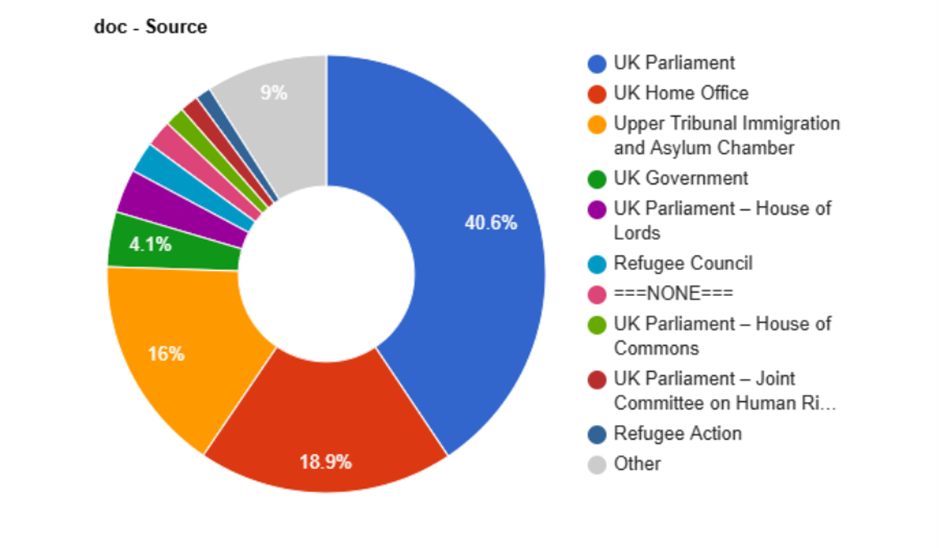
To address the questions posed above, and focusing specifically on the collected UK data, we have compiled a 63,703,942-word corpus on the ‘crisis’ of migration discourse from institutional and political texts published between 2014 and 2025. The corpus includes UK parliamentary texts; institutional materials published by the Home Office and its operational units including Border Force, UK Visas and Immigration and Immigration Enforcement; UK political party texts published primarily by the Labour Party, the Conservative Party and Reform UK; texts produced by international organisations, NGOs, and civil society actors; as well as judicial texts from UK courts and tribunals. Across these categories, the dataset includes research briefings, parliamentary debates, committee reports and evidence, policy papers, legislation, operational guidance, statistics, manifestos, speeches, campaign materials, advocacy documents and court and tribunal decisions. To compile our corpus, we selected 475 text files for the first research question, 316 text files for the second, and 300 text files for the third in order to trace the impact of discourses and policies on people using unauthorised routes to enter the EU and the UK – people who are, as a result, ‘illegalised’ (a term we use deliberately to reflect that illegality is a legal and political construction, not an inherent status) – across the period 2014–2025.
Our first research output is a report focusing on examining how narratives of ‘illegalised’ migration are constructed in institutional (political and policy) texts, and their impact on policymaking and migration governance in relation to migrants who are the main targets of these policies.
Findings: The language of institutional migration discourse in the UK
Findings from our corpus analysis of UK institutional migration texts reveal a striking picture of how migration is linguistically framed across government, parliamentary, NGO, and international organisation texts spanning 2014–2025.
The language of bureaucracy dominates
The noun frequency data reveals a fundamental asymmetry in UK institutional migration discourse: people seeking sanctuary who are most affected by these policies are systematically marginalised within the very texts that govern their lives. The corpus is overwhelmingly organised around bureaucratic subjects – applicant (714,837), requirement (373,975), application (363,508), permission (183,901), and decision (95,073) – terms that position migrants not as rights-bearing individuals but as cases to be processed and determined. By centring the applicant as a bureaucratic object rather than as a rights-holder individual, institutional language depoliticises migration, rendering what are fundamentally questions of human rights and state obligation as matters of procedural compliance.
Frequency disparities between semantically related terms further illuminate this structural orientation. Refugee (45,384) appears less than half as often as migrant (102,972) – a distinction with significant legal implications, given that 'refugee' carries specific protections under the 1951 Refugee Convention that the broader term 'migrant' does not invoke. The relative marginalisation of asylum (49,952), protection (49,663), and right (47,036) – each ranked far below terms of administrative process – indicates that the corpus is structurally oriented towards migration control rather than migrant protection. Notably, right (47,036) and refusal (69,315) occupy comparable positions in the frequency hierarchy, suggesting that the language of entitlement and the language of rejection are given near-equivalent discursive weight in UK institutional texts.
The verbs construct migration as a conditional process
The verb frequency list reinforces this picture. The most prominent verbs in the corpus – apply (256,054), meet (230,192), enter (227,136), grant (213,880), refuse (73,207), satisfy (72,540), and require (70,462) – together construct migration as a conditional process in which migrants must apply, prove and meet requirements in order to be granted or refused access to protection. The grammatical logic encoded in these verbs is one of gatekeeping: the state grants or refuses; the migrant applies or fails to satisfy.
Further down the frequency list – revoke (12,201), reject (13,033), cancel (17,746), overstay (20,306), and detain (3,717) – reveal an enforcement register in which the state revokes rights, cancels status, rejects claims, and detains bodies, constructing these acts not as exceptional measures but as the ordinary conclusion of the migration process. The verb detain is particularly revealing: in government texts it is constructed as a necessary administrative procedure facilitating removal and deterrence, while in NGO and advocacy texts it is contested as harmful, racially disproportionate, and applied to people – including children, pregnant women, and trafficking victims – who have committed no criminal offence.
Criminality and illegality are conflated
The adjective list sharpens this picture, moving from bureaucratic process to explicit moral and criminal categorisation. Criminal (8,105) and illegal (8,084) appear at near-identical frequencies – a finding that points to a systematic conflation of illegality and criminality in UK institutional language, constructing irregular migrants as inherently criminal rather than as individuals. These terms sit alongside false (7,963), reinforcing a pervasive discourse of suspicion and fraud detection. A further cluster of adjectives – genuine (12,410), credible (2,200), lawful (1,386), and authentic (1,373) – operates within the same logic of verification, constructing authenticity as something migrants must actively prove to a sceptical state, positioning them as presumptively suspect until demonstrated otherwise. Dangerous (1,341) also features in this register, pointing to an additional security framing in which certain migrants are constructed as threats to public order. This conflation is analytically significant: it locates the 'problem' of irregular migration not in systemic failures of safe and legal routes, but in the presumed moral deficiency of those who use them.
Competing registers: control versus protection
The highest-frequency adjectives – relevant (150,810), dependent (94,087), indefinite (90,634), civil (90,138), specified (81,403) – are overwhelmingly procedural, encoding a bureaucratic register in which migrants are defined by their relationship to rules, categories, and conditions. Set against these, terms such as humanitarian (26,981), compassionate (3,634), vulnerable (3,063), desperate (488), and inhumane (161) appear at markedly lower frequencies, concentrated in NGO and international organisation texts. The stark frequency gap between genuine (12,410) and inhumane (161) is itself analytically revealing: the question of whether a claim is authentic is given nearly nine times more discursive weight than the question of whether treatment is humane. This disparity points to a significant divergence between a state discourse of verification, control, and threat management, and a civil society discourse of rights, dignity, and humanitarian obligation.
The 'crisis' frame: contested and politicised
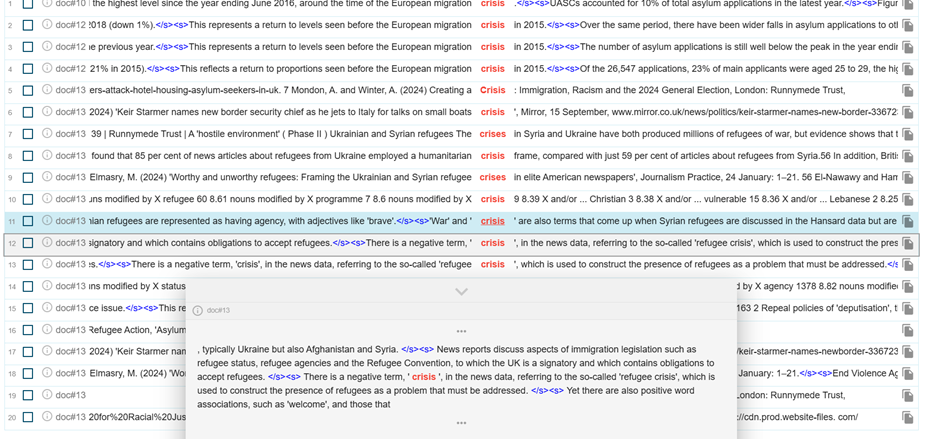
The term crisis appears 3,096 times across the corpus, yet its frequency belies a profound discursive instability. In government and parliamentary texts, crisis is constructed as an external phenomenon acting upon the state, naturalising the assumption that the volume of people seeking asylum is inherently problematic and that restriction is the appropriate response. In NGO, advocacy, and civil society organisations’ texts, the term is critically reattributed: the crisis is not migration itself but the state's response to it – its hostile environment policies, its dismantling of safe and legal routes, its systematic production of precarity. A third register, concentrated in international organisation texts, frames crisis in terms of global displacement and protection failure, invoking international legal obligations rather than national border management.
The same term is used by government actors to justify border restriction, by NGO and advocacy organisations to critique state violence and neglect, and by international bodies to invoke global protection obligations. This reveals that the 'migration crisis' is not a shared, neutral description of a situation but a contested political claim. What is at stake is a fundamental contestation over which institutional actors have the authority to name the problem and, in doing so, to determine the solution. This is a finding the full cross-country comparative analysis will examine in depth.
We will be sharing our report and key findings from the cross-country corpus analysis in the coming months. Further updates will follow as each strand of the project moves into the writing-up stage.
<